
What Is Performance Marketing? How to Pay for Results, Not Just Reach
What Is Performance Marketing? How to Pay for Results, Not Just Reach
Turn Insights Into Growth
Let’s discuss your business goals and work together on the right digital strategy to drive measurable, sustainable growth.
- 1What Performance Marketing Is (and What It Isn’t)1 min
- 2The Numbers Behind Every Performance Campaign1 min
- 3Choosing What Counts as a Result1 min
- 4Pricing Models, Budget, and Tracking1 min
- 5Where Performance Marketing Happens: The Main Channels1 min
- 6How AI Is Changing Performance Marketing1 min
- 7Measuring Campaign Performance and Improving1 min
- 8Common Mistakes That Waste Performance Budgets1 min
- 9How Dot IT Turns Ad Spend Into Measurable Growth1 min
- 10Stop Paying for Clicks That Go Nowhere1 min
- 11FAQs1 min
- 12Related Articles1 min
- 13Related Videos1 min
- 14Turn Your Advertising Spend Into Measurable Business Growth1 min
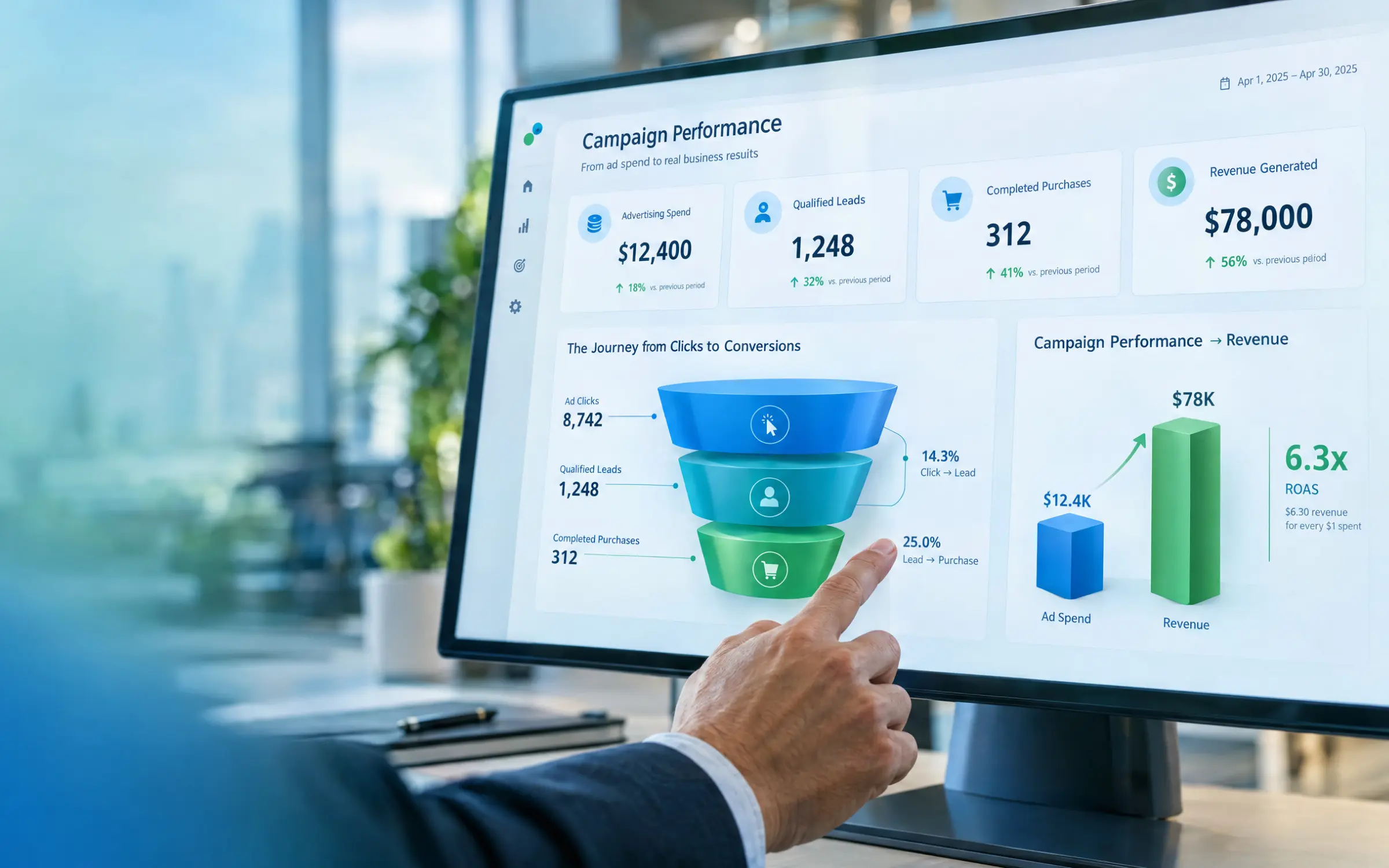
Every month, the report arrives. Impressions are up. Clicks look healthy. The follower count grew. But one question stays unanswered: what did all that spending actually bring in?
Performance marketing exists to answer that question. It’s a digital advertising approach where you define a measurable result, such as a lead, a booking, or a sale, and judge every campaign by how efficiently it delivers that result.
This guide explains how performance marketing works in practice: the numbers it depends on, how pricing and tracking fit together, where campaigns actually run, how AI is changing the work, and how to measure what’s paying off.
What Performance Marketing Is (and What It Isn’t)
At its core, performance marketing ties advertising spend to outcomes. Instead of buying exposure and hoping it works, you decide in advance what success looks like, track it, and move budget toward whatever produces it most efficiently.
Digital platforms make this possible. Google, Meta, LinkedIn, and other ad platforms can record what happens after someone sees or clicks an ad: whether they visit a page, fill in a form, call, or buy. That means you can compare campaigns by cost per result, not by how many people saw them.
Picture a dental clinic running ads. Measured by reach, a campaign that showed ads to 200,000 people looks impressive. Measured by performance, the real question is how many consultations it booked and at what cost per booking. That second view changes which campaigns get more budget.
Performance marketing also isn’t “just running ads.” It’s a way of planning, running, and measuring them. And it doesn’t replace brand building. Brand work creates the awareness and trust that performance campaigns then turn into measurable actions.
Brand work creates the awareness and trust that performance campaigns then turn into measurable actions.
The Numbers Behind Every Performance Campaign
Before choosing platforms or writing a single ad, you need a few business numbers. Without them, there’s no way to judge whether a campaign is profitable.
Start with customer value. For a one-time purchase, that’s the average order value. For services or repeat purchases, look at what a typical customer spends over the first year. Next, find your close rate: of every ten leads, how many become customers? Finally, identify the actions that signal real buying intent, such as a quote request, a booking, or an add-to-cart, rather than a page view.
These numbers let you work backward from a goal. To show how, here’s a hypothetical example. The figures are made up for illustration only. They aren’t industry benchmarks or real results, so replace them with your own numbers.
Imagine a service business that wants 20 new clients a month, closes 25% of its leads, and earns an average of $2,000 from each new client. It needs 80 leads a month. If it’s willing to spend up to 20% of new client revenue on acquisition, that’s $8,000 a month, so it can afford up to $100 per lead.
In this example, every campaign now has a clear test. A campaign delivering leads at $60 would be worth scaling. One stuck at $180 would need fixing or cutting. Your own limits will depend on your customer value, close rate, and margins.
From Ad Clicks to Business Results
Arts & Entertainment: $26.84
The lowest average cost per lead across 23 industries.
All Industries Average: $66.69
The average cost per lead across all 23 industries.
Real Estate: $102.51
One of the higher-cost industries for lead generation.
Attorneys & Legal Services: $131.63
The highest average cost per lead across 23 industries.
Choosing What Counts as a Result
With the numbers in place, decide what each campaign should optimize for. The right choice depends on how your business sells.
Online stores usually optimize for purchases and revenue, since the sale happens on the website. B2B companies and service providers typically focus on qualified leads, such as form submissions, calls, or consultation requests, because the deal closes later. Very new brands may start with traffic or engagement while they collect data, but they should move toward leads or sales as soon as they can.
Existing awareness shapes this decision too. People who already recognize your brand tend to click and convert more readily, so performance campaigns usually get cheaper as awareness grows. If you’re running brand activity alongside your campaigns, factor it into your expectations rather than treating the two as unrelated.
Pricing Models, Budget, and Tracking
Ad platforms charge in different ways, and each model fits a different goal:
| Model | You pay for | Best for | Watch out for |
| CPC (cost per click) | Each click on your ad | Search campaigns driving traffic to a page | Clicks that never convert |
| CPL (cost per lead) | Each lead generated | Lead generation for services and B2B | Low-quality leads that inflate volume |
| CPA (cost per acquisition) | Each completed conversion, often a sale | Mature campaigns with solid conversion data | Needs enough data to work well |
| CPM (cost per 1,000 impressions) | Ad views | Awareness campaigns running alongside performance campaigns | Reach without action |
For budget, avoid spreading money thinly across every channel at once. Start with the one or two channels most likely to deliver your target result, give each enough budget to collect meaningful data, and set a review point, such as after two to four weeks, to decide what to scale, fix, or stop.
The most important part of planning is tracking, and it must be in place before launch. That means conversion tracking on your website, platform tags or pixels installed and tested, and a way to connect leads to sales in your CRM. Launching without tracking means spending money you can’t evaluate.
Not sure your tracking would hold up? Ask Dot IT to review your setup before your next campaign goes live.
Where Performance Marketing Happens: The Main Channels
Each channel reaches people at a different point in their decision. The strongest results come when channels share the same goals, tracking, and message.
Search Advertising
Search ads, mainly through Google Ads, appear when people actively look for a product or service. That intent makes search one of the most efficient performance channels. The key is keyword choice: “emergency plumber near me” signals someone ready to call, while “how to fix a leaking pipe” signals someone still researching. Relevance matters too. Ads and landing pages that closely match the search tend to earn better positions at lower cost.
Social Media Advertising
Platforms like Facebook, Instagram, LinkedIn, and TikTok let you reach people based on their interests, behavior, demographics, or job roles, before they start searching. Because people aren’t looking for you yet, the creative does most of the work. A clear hook in the first seconds, a specific offer, and a strong visual usually matter more than any targeting setting.
Display, Video, and Retargeting
Most people don’t convert on their first visit. Retargeting shows ads to people who visited your site or engaged with your content, keeping you visible while they decide. Display and video, including YouTube, add reach and help explain products that need more than a few lines of text. Judge these campaigns by the conversions they support, not just their direct clicks.
Affiliate Marketing
In affiliate marketing, partners such as publishers, review sites, or creators promote your offer and earn a commission for each sale or lead they generate. It’s one of the purest pay-for-results models, since you pay only when a result happens. It works best for products with clear online conversions. Set clear rules on how partners can promote you, and monitor lead and sale quality closely.
Email Campaigns
Email converts people who already know you, at a very low cost per action. Use it to follow up with leads, bring back past visitors who signed up, and encourage repeat purchases. Automated flows, such as a welcome sequence after a first download or a reminder after an abandoned booking, turn one-time interest into results.
Landing Pages and Creative
Many campaigns fail after the click. If an ad promises a free consultation and the landing page shows a generic homepage, people leave. Build a page for each main campaign that repeats the ad’s promise in its headline, explains the offer in a few lines, and asks for one action only. Ask only for the details you truly need, and check how the page looks and loads on a phone, where most clicks happen. Test creative variations regularly too: small changes in the headline, image, or offer can shift results more than any bid adjustment.
Running Campaigns That Pay for Results
Explore how Dot IT runs paid campaigns across Google, Meta, and LinkedIn.
How AI Is Changing Performance Marketing
Ad platforms now automate much of the work that used to be manual. Google’s Performance Max, for example, runs one campaign across Google’s inventory, including Search, YouTube, Display, Gmail, Discover, and Maps. It uses Smart Bidding to bid in real-time auctions based on the likelihood of a conversion, and it can combine your assets into new ad variations. Meta offers its own automated campaign options under the Advantage+ name.
This shifts the marketer’s job. Instead of adjusting every bid and audience by hand, your results depend on the quality of what you give these systems: accurate conversion goals, strong creative assets, useful audience signals, and landing pages that convert.
The biggest risk is optimizing toward the wrong result. If you tell an automated campaign that a page view is a conversion, it will find you plenty of page views. If you track qualified leads or sales, it will work toward those. Clean, accurate conversion data is now one of the most important parts of performance marketing.
Measuring Campaign Performance and Improving
Measuring campaign performance means looking past surface numbers to the metrics that link to revenue:
- Conversion rate: the share of visitors who complete your target action. A low rate often points to a mismatch between ad, audience, and page.
- Customer acquisition cost: the total you spend to win one new customer. Set it against the customer value you calculated at the start.
- Return on ad spend: revenue generated for every unit of currency spent on ads.
- Click-through rate: useful as a diagnostic for ad relevance, but never a success measure on its own.
Performance marketing analytics combines data from tools like Google Analytics and ad platform dashboards to show how people move from ad to action. These tools have blind spots, though. Consent settings and privacy controls can hide some activity, people switch devices before converting, and sales that close by phone or in person may never reach your dashboard. Connecting CRM data closes much of that gap.
Then keep improving. Review results on a fixed schedule, move budget toward what delivers, test new creative, and fix weak landing pages. Small, steady gains in conversion rate and cost per lead compound into much better returns on the same budget.
Common Mistakes That Waste Performance Budgets
Reporting activity instead of outcomes: impressions, likes, and clicks are easy to report and say little about revenue. When reports stop there, nobody can see which campaigns work. Put leads, sales, and cost per result at the top of every report.
Launching without a defined goal: a campaign without a clear result can’t be optimized, and automated campaigns will optimize toward whatever you happen to track. Set one primary result and a target cost before launch.
Ads and landing pages that don’t match: when the offer or message changes after the click, you pay for visitors who were never going to convert. Give each main campaign a page built around its promise.
How Dot IT Turns Ad Spend Into Measurable Growth
Performance marketing only works when the numbers, the tracking, the campaigns, and the pages all connect. That’s the part Dot IT handles.
We begin with the economics: what a customer is worth to you, how your sales cycle works, and what a lead can cost while staying profitable. Then we build the measurement layer, so every campaign reports on real results from day one. Our media buying team runs campaigns across Google, Meta, LinkedIn, and other platforms, while our designers and developers produce the ad creative and the landing pages those campaigns depend on.
You can bring us in for the whole cycle, from strategy to reporting, or for a single piece that’s holding your results back, such as tracking, creative, or landing pages.
Stop Paying for Clicks That Go Nowhere
The difference between ad spend and investment is proof. Performance marketing gives you that proof, campaign by campaign, as long as the numbers, tracking, and pages are in place before the money goes out.
Ready to see exactly what your budget brings back? Talk to Dot IT about building performance campaigns around your revenue goals.
FAQs
What is performance marketing?
Performance marketing is digital advertising planned and judged by measurable results, such as leads, bookings, or sales. A clinic might measure cost per booked consultation, while an online store measures cost per order and revenue.
What is the difference between brand marketing and performance marketing?
Brand marketing builds recognition and preference over time, before people need you. Performance marketing turns existing demand into measurable actions now. Many businesses run both, because campaigns aimed at people who already know the brand tend to convert more efficiently.
What channels are used in performance marketing?
The core channels are search ads, social ads, display and video, retargeting, affiliate programs, and email. Which ones lead depends on whether your buyers already search for what you sell or need to discover it first.
How is AI changing performance marketing?
Automated campaign types now handle much of the bidding and placement, so the advertiser’s main job is feeding them accurate conversion data and strong creative. A common early step is reviewing which actions are marked as conversions, since automation will chase whatever is counted.
What is performance marketing analytics?
It’s the practice of combining ad platform data, website analytics, and CRM records to see which campaigns produce real revenue. The CRM piece matters most for businesses whose sales close by phone, in person, or weeks after the first click.
Related Articles





Related Videos
Ready to Get More from Your Ad Budget?
Turn Your Advertising Spend Into Measurable Business Growth
Reach the right audience, generate qualified leads, and understand what your campaigns are delivering. Let Dot IT help you build a performance-focused advertising strategy for your business in Egypt.


